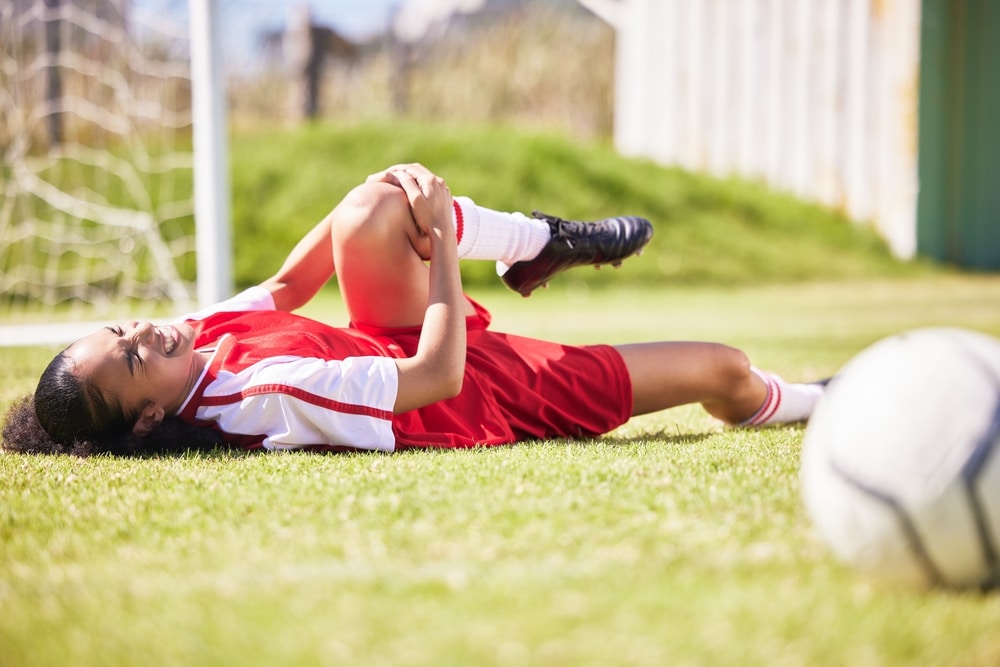
Women’s sport has grown enormously in recent years, with more women and girls participating in football, rugby, netball, hockey, skiing and other high-demand sports.
Alongside that growth, there has been increasing awareness of an injury that disproportionately affects female athletes: the anterior cruciate ligament (ACL) tear.
Research suggests that female athletes participating in comparable sports can have a substantially higher risk of ACL injury than their male counterparts. Some studies report a risk around four to six times higher, particularly in sports involving jumping, landing, sudden changes of direction and pivoting.
So why does this happen? There is unlikely to be one simple explanation. Instead, the increased risk appears to involve a combination of anatomy, biomechanics, muscle strength and control, joint laxity and potentially hormonal influences.
For women who have already injured their ACL, understanding these factors can also be useful when considering rehabilitation, surgery and eventually returning to sport.
What is the ACL and how is it injured?
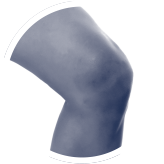
The ACL is one of the major ligaments inside the knee. It connects the femur (thigh bone) to the tibia (shin bone) and helps control forward movement and rotation of the knee.
Interestingly, many ACL injuries happen without another player making contact.
A typical injury might occur when you:
- suddenly change direction or pivot
- land awkwardly from a jump
- decelerate quickly
- twist while your foot remains planted.
You may feel or hear a ‘pop’, followed by pain and rapid swelling. Some people describe the knee immediately giving way.
Why are women more susceptible to ACL injuries?
There is no single ‘female ACL’ risk factor. Current research points towards several factors interacting with each other.
1. Differences in biomechanics
One of the strongest areas of research concerns the way forces travel through the hip, knee and ankle during landing, running and changing direction.
Female athletes may be more likely to demonstrate dynamic knee valgus during certain movements – where the knee moves inwards relative to the hip and foot. Differences in hip and knee flexion, rotation and landing mechanics can also increase the forces transmitted through the ACL.
Research examining female athletes through adolescence suggests that some of these biomechanical differences become more apparent following puberty.
Importantly, biomechanics are not necessarily fixed. Strength, movement-control and neuromuscular training can change the way an athlete lands, turns and absorbs force.
2. Muscle strength and neuromuscular control
The muscles surrounding the knee provide an important additional layer of stability.
The hamstrings are particularly important because they help resist forward movement of the tibia – one of the movements controlled by the ACL. Hip and gluteal strength also helps control the position of the thigh and knee during running, jumping and landing.
Relative differences in quadriceps and hamstring recruitment, hip strength and neuromuscular control may therefore contribute to ACL loading in some female athletes.
This is one reason why ACL prevention and rehabilitation programmes do much more than simply strengthen the knee. They usually incorporate hamstring and gluteal strengthening, balance, jumping, landing, agility and change-of-direction training.
Encouragingly, this appears to work. A recent systematic review found that neuromuscular training programmes incorporating strength, balance, agility and change-of-direction exercises substantially reduced ACL injuries in female athletes.
3. Joint laxity and hypermobility
Some people naturally have more flexible joints than others, and greater generalised joint laxity is more common in women.
If you are particularly flexible or hypermobile, your knee may rely more heavily on muscular control to provide stability during high-speed movements.
This does not mean that being hypermobile will inevitably lead to an ACL injury. However, it may be one part of an individual athlete’s risk profile and can be considered when planning strength and rehabilitation programmes.
4. Do female hormones affect the ACL?
This is an interesting area of research, but also one where we need to be cautious.
The ACL contains receptors that can respond to hormones including oestrogen and relaxin. Researchers have therefore investigated whether hormonal fluctuations during the menstrual cycle could temporarily affect ligament properties, joint laxity or neuromuscular control.
Some studies have found differences in ACL injury rates or knee laxity at different stages of the menstrual cycle. However, the evidence is inconsistent. More recent research suggests that although hormones such as oestrogen and relaxin can influence ligament tissue, normal menstrual-cycle fluctuations may not produce clinically meaningful changes in ligament laxity for every woman.
At present, there is not enough evidence to recommend that women avoid particular sports or training at a certain point in their menstrual cycle simply to prevent an ACL injury.
Hormones are therefore best viewed as one possible part of a much more complicated picture rather than the sole explanation for why ACL injuries are more common in female athletes.
I think I have torn my ACL – what happens next?
An ACL injury should be properly assessed, particularly if your knee became significantly swollen, you heard a pop or it continues to give way.
Diagnosis usually involves a clinical examination and an MRI scan, which can confirm the ACL tear and identify associated injuries such as meniscal tears, cartilage damage or injuries to other ligaments.
Importantly, an ACL tear does not automatically mean you need surgery.
ACL surgery or rehabilitation – which is better?
This decision depends on the individual rather than simply the MRI result.
Non-surgical treatment
A structured rehabilitation programme can be appropriate for some patients, particularly if the knee becomes stable and they do not need to return to sports involving frequent pivoting or rapid changes of direction.
Potential advantages include avoiding surgery and its associated risks and allowing you to begin rehabilitation immediately.
However, some people continue to experience episodes of instability or ‘giving way’. This may make returning to sports such as football, rugby, netball, hockey or skiing difficult and can potentially place other structures within the knee at risk.
ACL reconstruction
ACL reconstruction involves replacing the damaged ligament with a graft, commonly using one of the patient’s own tendons.
Surgery may be considered when there is ongoing instability, when associated knee injuries or more complex, multi ligament damage requires surgical treatment, or when a patient wants to return to demanding pivoting or cutting sports.
However, reconstruction is not a quick route back to sport. It requires a lengthy and carefully progressed rehabilitation programme, and return to sport should be based on strength, function, confidence and objective testing rather than time alone.
What does the research say about surgery versus rehabilitation?
Interestingly, research does not support the idea that every ACL rupture needs immediate reconstruction.
Randomised studies comparing early ACL reconstruction with structured rehabilitation followed by optional surgery have shown that a significant proportion of patients initially managed with rehabilitation do not subsequently require reconstruction.
In the COMPARE trial, approximately half of those initially allocated to rehabilitation ultimately underwent surgery. Early reconstruction produced somewhat better patient-reported outcomes at two years, but researchers noted that the clinical importance of the difference was uncertain – and importantly, half of the rehabilitation group avoided surgery altogether.
This highlights why treatment should be personalised.
Your age, sporting goals, degree of instability, associated injuries, occupation and willingness to undertake rehabilitation all matter. For a competitive footballer hoping to return to high-level pivoting sport, the decision may look very different from someone whose main goals are running, cycling and everyday fitness.
Getting back to sport
Whether you have ACL reconstruction or are treated without surgery, high-quality rehabilitation is essential.
Rehabilitation should restore strength, movement and confidence, but it should also address the factors that may have contributed to the original injury.
For female athletes in particular, this may include:
- quadriceps and hamstring strength
- hip and gluteal strength
- single-leg control
- jumping and landing technique
- balance and proprioception
- acceleration and deceleration
- cutting and change-of-direction mechanics
- sport-specific conditioning.
An ACL injury can feel like a major setback, particularly if sport is an important part of your life. However, with an accurate diagnosis, an individualised treatment plan and appropriately progressed rehabilitation, many women successfully return to active lifestyles and competitive sport.
At London Bridge Orthopaedics, our knee specialists assess ACL injuries alongside any associated meniscal, cartilage or ligament damage and can discuss both surgical and non-surgical treatment options based on your knee, your sport and your individual goals.
KNEE SPECIALISTS IMAGES and clickable links to their profiles.
FAQs
Are women really more likely to tear their ACL than men?
Yes. Studies of comparable sports consistently demonstrate a higher ACL injury rate among female athletes. The exact difference varies between sports and populations, but research has reported rates several times higher in women.
Does having an ACL tear mean I definitely need surgery?
No. Some ACL tears can be successfully managed with structured rehabilitation. Surgery is more likely to be considered when the knee remains unstable, there are associated injuries, or you want to return to sports involving significant pivoting and change of direction.
Can I play sport without an ACL?
Some people can return to certain activities without ACL reconstruction, particularly straight-line activities such as running and cycling. Returning to high-demand pivoting sports can be more challenging if the knee remains unstable.
Does my menstrual cycle increase my risk of an ACL injury?
Hormones may influence ligament tissue, and some research has identified differences in injury risk at different stages of the menstrual cycle. However, the evidence remains inconsistent and is not currently strong enough to recommend avoiding training or competition during particular phases of the cycle.
Does hypermobility increase ACL injury risk?
Greater joint laxity may contribute to ACL injury risk in some people, but it is only one factor. Good strength and neuromuscular control can help stabilise the knee, so rehabilitation and injury-prevention programmes can be particularly valuable for hypermobile athletes.
Can ACL injuries in women be prevented?
Not every ACL injury can be prevented, but targeted neuromuscular training can significantly reduce risk. Programmes typically include strength, balance, landing technique, agility and change-of-direction exercises and are particularly valuable in sports such as football, rugby, hockey, basketball and netball.
References
- Ramachandran, A.K. et al. (2024) ‘Changes in lower limb biomechanics across various stages of maturation and implications for ACL injury risk in female athletes: a systematic review’, Sports Medicine, 54, pp. 1851–1876. Article
- Gilmer, G., Crasta, N. and Tanaka, M.J. (2025) ‘The effect of sex hormones on joint ligament properties: a systematic review and meta-analysis’, American Journal of Sports Medicine, 53(11), pp. 2738–2748. Article
- Reijman, M. et al. (2021) ‘Early surgical reconstruction versus rehabilitation with elective delayed reconstruction for patients with anterior cruciate ligament rupture: COMPARE randomised controlled trial’, BMJ, 372, n375. Article
- ‘Prevention strategies for lower extremity injury: a systematic review and meta-analyses for the Female, woman and/or girl Athlete Injury pRevention (FAIR) consensus’ (2025), British Journal of Sports Medicine. Article
- ‘Sex specific considerations in anterior cruciate ligament injuries in the female athlete: State of the art’ (2024), Journal of ISAKOS, 9(6), 100325. Article