Home | Blog | Musculoskeletal Examination Techniques: Enhancing Diagnostic Accuracy in Primary Care
Musculoskeletal Examination Techniques: Enhancing Diagnostic Accuracy in Primary Care
Musculoskeletal Examination Techniques: Enhancing Diagnostic Accuracy in Primary Care
A clear, structured MSK examination is one of the most valuable tools in primary care. With time pressures and increasingly complex presentations, a repeatable, efficient approach helps GPs and physiotherapists differentiate simple from serious pathology and identify when early orthopaedic input is required.
A Simple, Time-Efficient Framework – Look, Feel, Move, Test
1. Look
Observe posture, swelling, deformity, bruising, muscle wasting or asymmetry.
Assess gait, weight-bearing and functional tasks (sit-to-stand, step-up, hand grip).
2. Feel
Palpate for warmth, tenderness, effusion, crepitus, and focal trigger points.
Compare bilaterally and identify structures in a logical order: bone → joint line → tendon → muscle → neurovascular structures.
3. Move
Active ROM
Ask the patient to move fully through flexion, extension, abduction/adduction, and rotational movements. Note pain, restriction or compensatory patterns.
Passive ROM
Helps differentiate capsular/joint restriction from muscular/soft-tissue restriction.
Pain on passive movement often suggests intra-articular pathology.
Resisted Movements
Quick screening for muscle strength, tendon integrity, and pain provocation.
4 Test: Key Special Tests for Primary Care
Shoulder
Jobe (Empty Can): supraspinatus dysfunction.
Hawkins–Kennedy / Neer: impingement signs.
External rotation lag: infraspinatus tears (useful in older patients).
Knee
Lachman: most sensitive test for ACL rupture.
Joint line tenderness + McMurray: meniscal involvement.
Patellar grind: patellofemoral pain.
Hip
FABER: intra-articular hip pathology/SIJ discomfort.
FADIR: femoroacetabular impingement.
Trendelenburg: gluteal weakness or abductor tendon pathology.
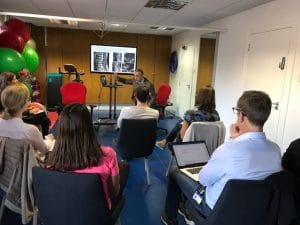
The Spinal surgeon, Mr Bahram Fakouri, gave an update to a group of city-based physio’s from Central Health at their clinic in Chancery Lane. A wide range of topics was discussed including spinal stenosis diagnosis and management, medications and epidural ... Read more